I am not sure how it started, but in the last couple of years I have been supporting St Anthony’s friars based in Padua, Italy. As a consequence, I am regularly sent a magazine called “Il Messaggero” ( the English version is “The Messenger”). I am not an avid reader of all sorts of publications, but I must admit I find this magazine very enjoyable and I read it with interest.
When planning our biannual holiday to Northern Italy this year, the idea came to me that it would be nice to include Padua in our itinerary. Perhaps, I thought, we might even meet some of those nice monks! So, despite the fact that Padua is quite a long way away from our usual area of Turin, I carefully considered what our trip should involve and we concluded that we could take that diversion after all.
I know that some people have a strong devotion for St Anthony. I didn’t know too much about him, apart from the fact he is associated with Padua and that we can turn to him for help to find a lost object. In fact, I only found out recently that he wasn’t Italian, but came from Lisbon, in Portugal. His original name was Fernando, but he changed it to Anthony when he joined the Franciscan friars. He eventually settled in Italy and ended up in Padua where he is buried. He was a contemporary of St Francis of Assisi and the two of them briefly met.
Something quite remarkable is that, as I discovered after planning our trip, the day we had chosen to arrive in Padua was the very day of the feast of St Anthony, June 13th. When we planned our holiday in detail we had no idea that we would be there on that occasion! Had St Anthony actually led us to visit him in this special way? We also learned that, in the period prior to our trip, we could take part in a 13-day devotion by following a daily online video especially prepared by the friars. We started this in England and, thanks to our mobile phones, we were able to complete the devotion on the last day in Turin, just before travelling to Padua.
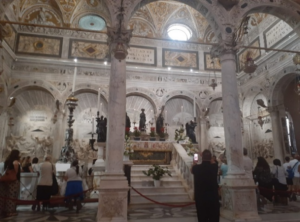
St Anthony is buried in the Basilica and people approach the slab of his tomb and touch it whilst offering their petition to the saint. His relics are also kept there. Incidentally, in Padua St Anthony is commonly referred to as ‘The Saint’.
So, on June 13th, we arrived in Padua and we were prepared to see quite a few people turning up for the celebrations. And it was an even bigger event than we had expected. In fact, the first pilgrims arrived at St Anthony’s Basilica for its first service at 6am and Masses were said continuously every hour throughout the day. We only arrived in the late afternoon and found a huge crowd, both in the square and in the Basilica. However, we weren’t too late for the main event.
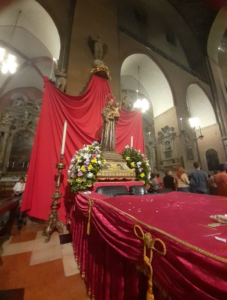
A procession carrying the statue of The Saint and his relics from the church into the streets was due to start after the end of the 5pm Mass.
Whilst waiting for the event, we wandered around the surrounding streets and bought some ‘Pane di Sant’Antonio’ (Saint Anthony’s bread) in a café, which we ate there. Only later did we learn that the tradition is to buy that bread and have it blessed in memory of The Saint’s miracle when he brought back to life a little boy who had drowned and whose mother vowed to donate to the poor an amount of wheat corresponding to her little son’s weight.
When I booked our accommodation earlier this year, I chose a location not too far from the Basilica. However, we never expected to end up with a room with a view of the square and from which we could observe the whole of the procession without any obstacle and avoiding the crowds! Another ‘special treatment’ by Saint Anthony?
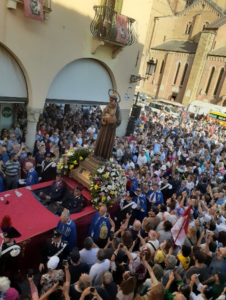
We were surprised when we realised that this annual event is attended not just by the locals, but by pilgrims from so many different parts of the world, like Romania, Sri Lanka, India and Malta.
In conclusion, we were very pleased to have got closer to St Anthony through our unexpected pilgrimage. All I can say is: “Thank you, St Anthony, for leading us to Padua on June 13th!”
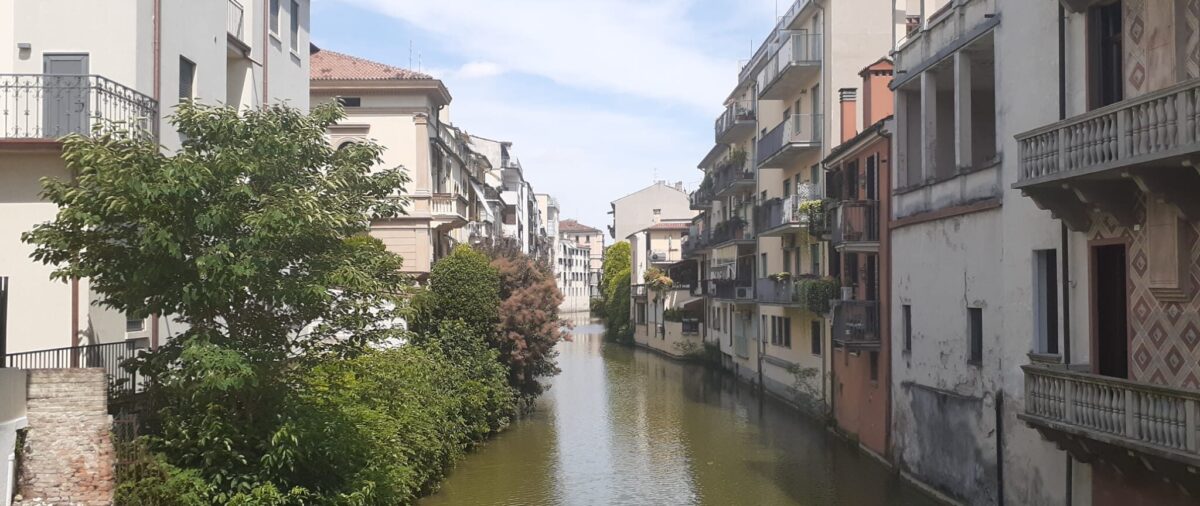
We spent a couple of days in Padua. However, we ought to have spent at least a day longer. If you ever decide to visit Padua I would recommend you don’t underestimate the beauty of this ancient university city and allow enough time to fully explore it.
Giorgio Chiosso